Next

Sometime towards the end of summer I took my daughter and a fellow teen friend to the mall. Near the end of the outing I needed a bathroom break and the closest restroom had a short line of women waiting. I joined the wall of resting backs and side leaning shoulders. A hallway that may have been filled with idle chitchat seemed quieter under face masks and bags of purchases created little forts around each woman’s feet. When the door swung open to admit the next person in line the exiting woman peered out at the waiting people and apologized, “Oh, I’m sorry.” and she hurried past. Two more women joined the wait behind me, one with a back to the wall and the other erect with arms crossed. After some time the woman who was second in my wait emerged with one babe on her hip and another holding her hand. She too apologized to everyone as she stepped out. The pattern played on. I wondered why in the world these women were apologizing. Were we not all in line for the same reason? Are we sorry for another person waiting? Is waiting an inconvenience or perhaps simply occupying space? Who knows — maybe all and maybe some or none of that. What I did know was that I would not feel bad about a bodily need when it was my turn and I would not apologize when I stepped out.

When I did walk out, I decided to say, “Next!” with a smile that my eyes had to convey.

Women over apologizing isn’t a new topic. I remember reading about the issue in a magazine when I was a teenager — long before taking my own teenager shopping. No matter your sex, perpetuating unhealthy patterns is something we can all examine and decide to change if needed. Save your apologizes for when they’re truly meant and let your words carry their weight with intention. With attention to exactly what you are saying, you may have more joy in whatever comes next for you.
Pebble Meditation

This is a guided breathing awareness meditation with pebble visualization for relaxation and insight. You can choose any intention or focus area ahead of listening to the recording. If you’re at a loss for what that may look like, you could consider ideas such as “I intend to see clearly my next steps.”, ”I intend to live with more joy.”, “I intend to release blocks around my self expression.”, or perhaps “I intend to connect authentically with others.” These are starting points, but feel free to move with any intention or theme. What you choose ahead will guide you best as you know you need.

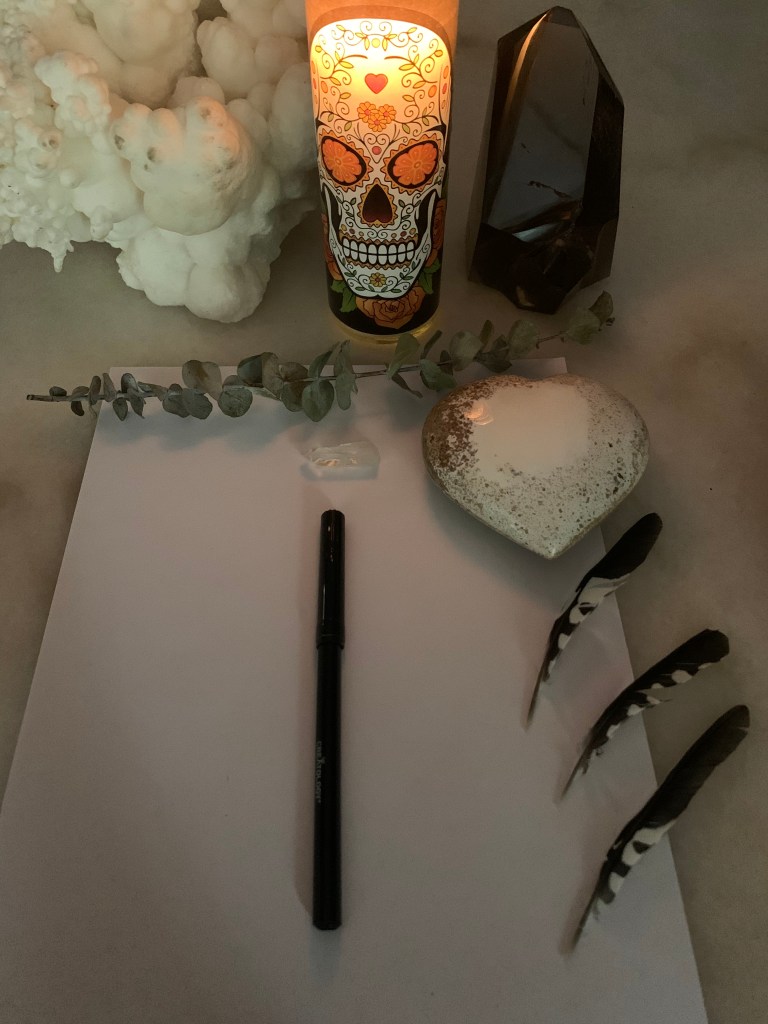
For the exercise, gather paper and pen. Write your intention out on the paper and speak it aloud or in your head three times. Prepare yourself to sit comfortably in a chair, keep the paper and pen close by to make notes after listening to the recording. Start the recording and close your eyes. ✨🙏🏼✨

Link to Recording:

https://drive.google.com/file/d/1vvgPWyNmeniiNV-2tS5oEfWDG4jpnu9M/view?usp=drivesdk

(This recording has sounds not too far off in the background. With the spirit of mindful awareness, if you find yourself distracted by the background sounds, let that be, and gently guide yourself to focus on the sound of my voice. If you find your mind wandering, practice in the same way, with gentle guidance back to the voice.)

Design

“If we see every situation as perfectly designed for our own movement and growth, and we can embrace every situation for where it comes from and where it leads us… neither [disparaging yourself] nor others… recognizing that all unhealthy thoughts, words, and actions are expressions of unmet needs… [you may] remain unfailingly affirmative in relationship to both [yourself] and others.”

Moore, Coaching Psychology Manual

Begin

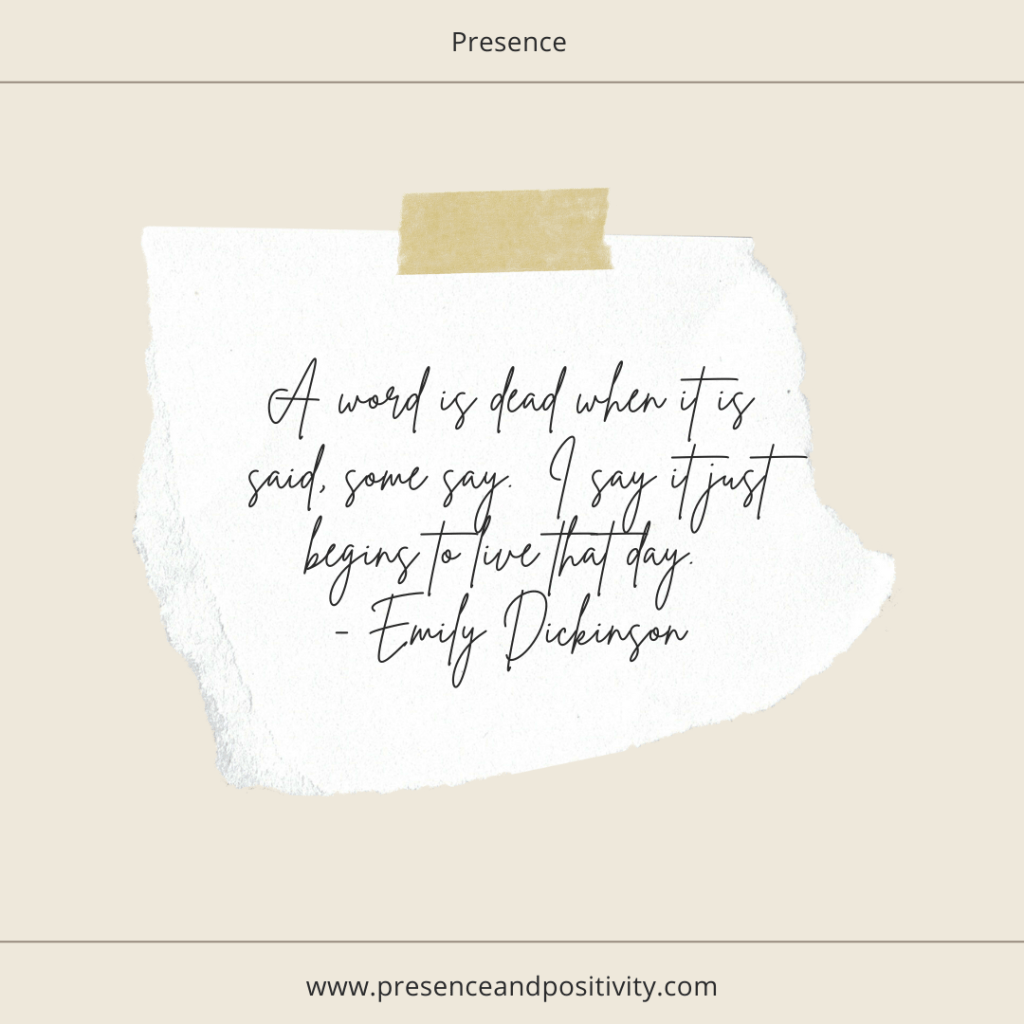
“ A word is dead when it is said, some say. I say it just begins to live that day.”

Emily Dickinson

What are you bringing to life with your words? Does what you’re saying match what you want to hear yourself saying? Take a moment, pause, and listen. Are you speaking from a place of not having what you want or from the place of having it all worked out?

What would it feel like to try on reality as you want and pretend it’s happening now? You may have to get into the world of make believe that was probably natural to you in childhood. Take anything that’s presenting in your life now and look carefully at how you think and speak about the topic. Does your thought and speech support the status quo or the desired result?

Example:

You want a sense of community at work.

From the place of not having what you want you may think and say:

“No one makes an effort to speak to each other. We sit at our desks and keep to ourselves.”

From the ideal scenario you may say:

“It’s so easy to connect with my coworkers. We are thoughtful about professional and personal needs. I’m so grateful that we all work well together.”

It may seem odd to say something you don’t currently see happening. Take it as a game or experiment if that’s the case and see if it shifts. Either way, you can revel in ideals for a moment or two.

Rising

Words from Carl Jung, 20th century analytical psychologist, in support of learning to shift and widen your focus away from what you don’t want toward what you do want to experience:

“The greatest and most important problems of life are all in a certain sense insoluble… They can never be solved, but only outgrown… This “outgrowing,” as I formally called it, on further experience was seen to consist in a new level of consciousness. Some higher or wider interest arose on the person’s horizon, and through this widening of view, the insoluble problem lost its urgency. It was not solved logically in its own terms, but faded out when confronted with a new and stronger life-tendency.”

What new interest could be on the horizon for you?

Make up your Mind

“Folks are about as happy as they make up their minds to be.” – Abraham Lincoln

Let joy be gathered, briefly held, appreciated, and gently released. Moments are meant to be fleeting but the joy you feel can go with you and create the foundation for noticing with more awareness, conscious savoring, and a deep appreciation for what life offers you today.

How can you give more of your attention to what brings you joy?

What will support and amplify your overall happiness in this day?


What do you do?

What do you do?
How many times have you asked this to inquire about occupation? What prompts you to ask this?

Will it draw you together in similarity or possibly create a divide in interests with another? What is the importance of the occupation of another person in conversing with them and coming to know them? Would you like to assess their earning capacity? Would you like to gather all the ideas you have about an occupation and pin that on them? You may not intend to do either of those, but it could follow your asking simply because of the categorical nature of the brain.

A lot of people are doing a job because it’s a job. It may have nothing to do with their true interests or their gifts. If the person had a supportive environment growing up and the luxury to let their intuition guide their choices, then this could be a wonderful question to ask but if life circumstances have been less than ideal or if certain prescribed ideas about security guided work decisions, this question may be the source of discomfort or gateway to a false front.

There was an article about this sometimes menacing question in The New Yorker a few years ago and after coming across it I began to pay attention to how often it pops up in conversations as well as how much others do or do not attach themselves to their occupation. It’s interesting to observe… and leads me to ask you to consider:

How may exchanges form when you allow overly used questions to take rest? How could you try finding a new way to approach the same old question either in the asking or the response?

There are all sorts of things we each do everyday. Perhaps those seem too perfunctory to mention, but also perhaps they create the common ground that causes us to seek communication.

I stand. I breathe. I stretch. I read. I write. I breathe. I hum. I speak. I smile. I clean. I watch. I breathe. I walk. I drive. I work. I watch. I listen. I laugh. I think. I feel. I overthink. I breathe.

What do you do?


Willing

“Tell me the truth,” I asked love,

“What are you?”

“I am the everlasting life,” love said,

“I am the recurring joy of living.”

– RUMI


What about your current thinking may keep you in resonance with outdated patterns? What has been categorized as definite that could benefit from less black and white perspective? Where is the grey space? Where is the light creeping in? Could your aha moment be hiding out in there? Could a little more ________ ( inspiration, understanding, joy, fill in the blank for what fits for you at this time) be there too?

Whatever it is that’s happening in your life now, what would be different if you were in consultation with your heart and letting that dictate your next movement?

What does loving compassion have to say?

What if a simple willingness to ask yourself what your heart has to say could clear up what’s foggy, loosen the grip on what’s tense, or lift a burden that you’ve been hauling. Willingness to show up from a place of love (directed at yourself, perhaps another, or a situation) may offer you the opportunity to color your life with more vibrancy and hues fit for your best to come forward. There’s no need for perfection in coloring, only you willing to be genuinely you while love does the rest.

Persist

“Be kind to your heart. You may believe it to be weary… yet still it beats. Still it persists, with unquestioning allegiance to life. What a grand heart it is, this sacred heart of yours. How can it be worthy of anything other than tenderness, gratitude, acknowledgement, and appreciation?”
Alana Fairchild